

PX FARMS: HELPING BUILD A BETTER FUTURE
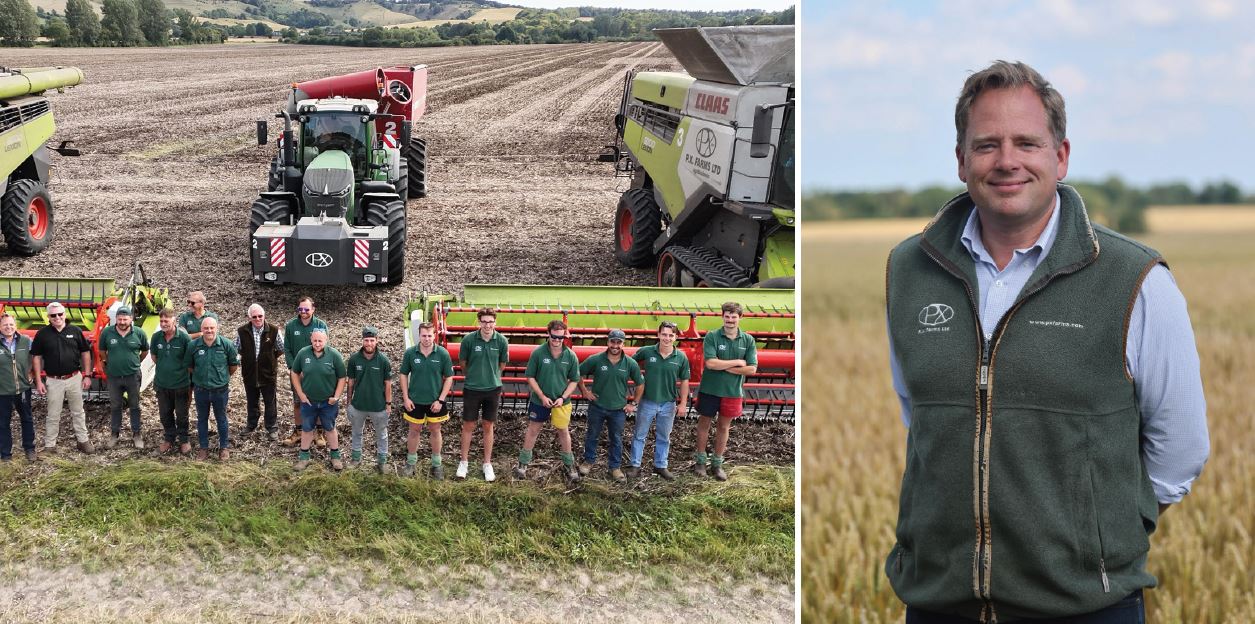
James Peck returned to the family farm in 1999 and started PX Farms in 2003. The family became one of the first businesses he contract farmed. Over 20 years later, James purchased the family farm, which was always a long term plan and today, he and his team work hard to diversify the business, developing more sustainable agricultural practices. We recently caught up with James to find how the farm is growing from strength to strength…
TELL US ABOUT THE FARM AND WHAT YOU DO?
After studying at Lackham Agricultural College and Writtle Agricultural College (university) and then managing Peck’s Contracting Services for five years, I took on the family farm of 750 acres and 150 acres in contract, under P.X. Farms Ltd. Today, we farm 12,500 acres (8,500 around Cambridge, 2,000 in Lincolnshire, and 2,000 in Bedfordshire / Hertfordshire) with a mixture of rentals, owned land, and contract farming. Most of the land is within an 18-mile radius of Scotland Farm, in Cambridge, but there is also land 71 miles away in one direction and 34 miles in another. A proud moment was when I won the Farmers Weekly Firestone Young Farmer of the Year award in 2006 and, in 2010, was awarded a prestigious Nuffield Farming Scholarship to study the future of arable farming.
Today, we are a modern family agribusiness, embracing diversification from just outside Cambridge in the UK and future proofing the family farm and those of our farming partners. We continue to grow the P.X. Farms brand with an expert team specialising in farming, crop storage, crop lab testing, haulage, crop hospital, lettings, and building. Have 51 people working with us now, as a mix of full and part-time work along with casual workers joining us for the harvest season.
We offer over 100,000 tonnes of crop storage and have a fully accredited lab with 16 crop tests to help make better decisions. In addition, we have two calibrated weighbridges to get more precise data and sample taking of the grain. Our delivery service hauls combinable crops, fertilisers, and agricultural products around the UK with our reliable VOSA registered fleet and experienced drivers. We’ve seen underused farm buildings developed into successful office units and residential lettings, as well as land not viable for farming used in more diverse ways.
Our customers vary in their type from Blue Chip companies to other land owners, institutions and residential and commercial tenants.
HOW HAS THE BUSINESS CHANGED OVER THE PAST 10 YEARS
Since 2014 the business has doubled in size, now farming over 12,500 acres. We have grown by setting out to farm for others. Our ethos is to “Adapt, Innovate and Overcome.” However, like most land owners and farmers, it’s not an easy ride. The change in subsidies has caused a gap in the finances, the timing of the drilling as a result of poor weather conditions has led to a reduction in yields and so our biggest challenges at the moment are the weather and the Government!
The future of farming is twofold for me: it’s about supporting and working together through the challenging times and celebrating the good times, and it’s also about combining scale for efficiencies of economies and specialism to build value.
We’ve decided as a business that we want to focus on growing crops. Producing food, that is our role in society. We do a lot of environmental work and regenerative agriculture. We need to find the right balance.
BALANCING FARMING AND THE ENVIRONMENT
By taking better care of our soil and coupling innovation with regenerative farming practices, we’re able to work in better harmony with the countryside. Soil health is at the heart of what we do. How do we reduce the impact on the environment yet still increase our crop yield and farming efficiencies for our own and partner farms? By taking care of our soil. Our soil health management supports growing clean quality crops from rich living soil with plenty of micro-organisms. By improving organic matter, we encourage soil health and reduce the need for pesticides, preventing resistant weeds with reduced variable input demand.
We reduce the intensity of farming through regenerative agriculture practices. We measure, evaluate, and plan how to introduce regenerative farming practices on every piece of land we take on. We’re always trying to repair and improve soil health and maximise species diversity. And our existing services, like our lab and our crop hospital, help identify challenges and how best to move forward.
I undertook a Nuffield Scholarship back in 2010, “Arable Farming, Where Next?” and travelled the world, studying farming practices in Europe, the USA, Canada, Australia, New Zealand, China, India, and Argentina. One of the key takeaways was how innovative practices are progressing positive change, and Controlled Traffic Farming (CTF) adoption was essential for P.X. Farms as part of James’ Adapt | Innovate | Overcome ethos. CTF is where you adjust all your machinery to run on the same tramlines, reducing the compaction and damage to soil.
We’ve adjusted all our machinery axle widths to 11.9m width and 1.8m internal track spacing. This has reduced fuel cost by an average of 12%, improved soil health and crop yield with less compacted soil, improved drainage, and reduced wear and tear on machinery.
CTF has helped us improve our soil quality across our and our partner farms to the point that we’ve been able to grow different crops in varying soil structures. Yield and nutrient mapping also helps us quickly detect weed, nutrient deficiency, drainage and soil compaction issues. Part of our long-term soil health strategy, we’re able to implement a more targeted, efficient approach to increase soil potential and help areas that require more attention. By gathering important data over time, we can make more informed decisions and review performance over time, adjusting as we need. In addition, by using GPS with fixed-position base stations to transmit signals, our applications can be more accurate. Aligning with the base stations helps to correct positioning errors caused by the atmosphere.
Our precision drill and sprayer machinery has sectional control from Real Time Kinematic (RTK), reducing inputs by 3-5%, resulting in less pollution. We use a sprayer instead of a spinning disc to increase accuracy and precision which is less affected by factors like wind, helping us apply the correct quantities to the land. We have continued to implement new approaches, test what works and what doesn’t, and continue innovating.
SPREADING THE WORD TO NEW AUDIENCES
In 2011, we started the PX Farms You Tube Channel, allowing viewers to share in our daily struggles, and triumphs of running the farm business. Honest and raw, it shows what British Agriculture is all about and I am really proud that we now have almost 17,000 followers and have posted over 112 informative videos which had over 2 million views. You can follow James and life at PX Farms visit: youtube.com@PX_Farms

WHEN DID YOU START USING WITHAM GROUP?
I met Nigel from Witham Group back in the year 2000 at a farming show, Witham has a man Neil Benstead on the ground to manage our oils and high life grease which fits well with our business. We get everything from Oils to Grease to Paint from Witham Group and these then go into Tractors, Combines and forklifts.
Service and warranty validation are really important to us and at certain times of the year we run 24 hours, 7 days a week, so we need partners who can support us during these high pressure times. Witham Group provides that for us and we have a great working relationship.


Leave a Reply