
DISPELLING THE MYTHS OF OIL PURCHASES IN THE UK
The following article by the United Kingdom Lubricants Association (UKLA) provides answers to some common questions and misconceptions about the supply, purchase and use of lubricants and cooling fluids in the UK.
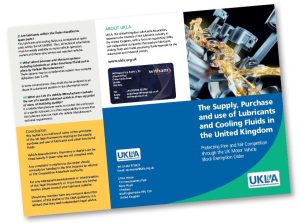
The UKLA has produced a helpful leaflet which clarifies and outlines of some of the principles of the UK legal framework relating to the supply, purchase and use of lubricants and other functional fluids. Vehicle Manufacturers, importers or dealers can be fined heavily if these rules are not complied with. This may be particularly helpful to all our customers who may have heard different rumours about buying oil from suppliers that may jeopardise a warranty. We hope this goes some way to clarifying this issue for you.
The rights of third-party actors to provide OEM quality parts to the automotive aftermarket is protected in UK law within the Motor Vehicle Block Exemption Order (MVBEO). This Order replaced the EU Motor Vehicle Block Exemption Regulation which was ported over into UK law when the UK left the European Union and is based on safeguards contained in the Treaty of Rome which regulates competition in the European Union.
The MVBEO provides safeguards against anti-competitive practice amongst suppliers, manufacturers and distributors in the automotive sector in return for limiting those rights amongst automotive manufacturers and distributors that would curtail free and fair competition.
Amongst the rights contained in the Order are the right of third-party actors to supply OEM matching quality parts to the automotive aftermarket including lubricants and cooling fluids, the right to access relevant OEM technical information with which to develop, produce and supply OEM matching quality parts based on market standards and OEM specifications, and the right to have unfettered access to be able to supply these OEM matching quality parts without encumbrance to the automotive aftermarket.
In the UK, responsibility for the enforcement and monitoring of these rights comes under the Competition and Markets Authority, CMA, a non-ministerial government department of the Department for Business & Trade.
- Can the Vehicle Manufacturer impose, for its vehicles, the use of its own lubricants and other fluids or those of a named lubricant manufacturer?
No, except when the Vehicle Manufacturer is paying for the products (e.g. free servicing, warranty repairs, and recall work). - Can the Vehicle Manufacturer recommend, for its vehicles, the use of its own lubricants and other fluids or those of a named lubricant manufacturer?
Yes, simple recommendations are allowed, but they cannot be made mandatory. OEM recommendations should always be accompanied by a relevant specification or market standard that allows the vehicle owner to correctly identify and have the choice of which lubricants and cooling fluids they wish to use in their vehicle at the same time as providing the recommendation.
The Vehicle Manufacturer can only impose minimum quality and performance levels linked to a market standard or technical specification such as those of API, ACEA or the Manufacturer standard. All OEM’s have their own branded oils which use ACEA/API as a base line only and have extra performance tests, or more severe tests. - Is it true that the warranty would be inapplicable if the Vehicle Manufacturer recommendation is not followed?
No, the Vehicle Manufacturer cannot withdraw its warranty if matching quality lubricants and other functional fluids meet the Vehicle Manufacturer requirements regarding quality and technical performance. The Competition & Markets Authority will not hesitate to initiate proceedings if a vehicle manufacturer would threaten not to honour its warranty because of the use of a product of matching quality. - How can I obtain technical requirements about lubricants and other functional fluids?
Vehicle Manufacturers have to provide all technical information, so called Repair and Maintenance Information or RMI, including technical specifications on lubricants and other functional fluids, to whoever services or uses, maintains or repairs these products to enable their correct application. - Can I, as a customer, choose the lubricant of my choice as long as it meets the Vehicle Manufacturer specifications?
Yes, you are free to choose the brand of your choice as long as it meets the technical requirements of the Vehicle Manufacturer and is of matching quality. - I have a contract with a Vehicle Manufacturer. What about a non-compete obligation in the contract regarding lubricants or other functional fluids?
You must be aware that a non-compete obligation agreed between you and a Vehicle Manufacturer (VM) regarding lubricants or other functional fluids could fall inside the scope of the UK MVBEO provisions on vertical restraints because of the important market share of the VM in the aftermarket sector, (more than 30%). These agreements take place between firms operating at different levels of the production or distribution chain.
In some circumstances, minimum purchasing obligations calculated based on your total annual requirements may also fall inside the scope of this Order. - What about fixed price maintenance package offers, including lubricants, which I may be asked to handle?
Firstly, the Vehicle Manufacturer and reseller cannot dictate a selling price to a consumer. It would be severely punished under Resale Price Maintenance Law. Secondly, if maintenance package offers include specified lubricants and prevent a vehicle reseller from buying competitive products, they would be interpreted as a non-compete obligation. (See question N°6). - Are lubricants within the Order classified as spare parts?
Yes, lubricants and cooling fluids are considered as spare parts within the UK MVBEO. Thus, all technical information must be readily available to motor vehicle operators, owners and those who service and maintain vehicles. - What about bonuses and discount systems including lubricants or other functional fluids put in place by Vehicle Manufacturers?
These systems may be considered as indirect non-compete obligations (see question N°6). In some circumstances, they could also be analysed as an abuse of a dominant position in the aftermarket sector. - What can I do if a Vehicle Manufacturer contests the use of a specific lubricant which is, from my point of view, of matching quality?
If a Vehicle Manufacturer wants to contest the use by you of a specific lubricant, it is their responsibility to prove that this lubricant does not meet the Vehicle Manufacturer’s technical requirements.
Conclusion
The UKLA leaflet is now available to any customer that would like further information on the principles of the UK legal framework relating to the supply, purchase and use of lubricants and other functional fluids. The advice found within this new leaflet is an overview of the key points and it is not intended to be an exhaustive list of issues. Therefore, please do not hesitate to contact us at Witham Group if you have any questions or need advice on this important issue.
ABOUT THE UKLA
The UKLA, the United Kingdom Lubricants Association, represents the interests of the lubricants industry in the United Kingdom, with a focus on supporting SMEs and independent companies that produce lubricants, cooling fluids and metal processing fluids essential for the automotive and industrial sectors.


Leave a Reply